Nina Khosla

Co-Creative Director of Ossou and Founder of FFORME New York, NY

PHOTOGRAPHY
Lelanie Foster

Nina Khosla

Nina Khosla, the Co-Creative Director of OSSOU and Founder of FFORME, is a driven, visionary builder whose instinct for form and perspective shapes both her brands and the worlds she is creating. She approaches design with a quiet rigor shaped as much by instinct as by intellect. Rooted in the tension between precision and feeling, her work has evolved over the years from an analytical beginning toward something more emotional, more lived-in.

We sat down with Nina to talk about how she understands clothing not simply as something worn, but as something inhabited: objects that move with the body, accumulate meaning, and reflect who we are becoming. Moving between disciplines and ideas—from denim to sculpture, from engineering to intuition—her practice unfolds slowly, deliberately, allowing each piece the time to find its form. OSSOU emerges from this rhythm, shaped by a point of view that is both exacting and deeply personal.

OSSOU: What are you personally building right now—inside OSSOU and beyond—that feels most alive to you?

NINA KHOSLA: My main personal projects right now are decorating my apartment, and designing a piece of jewelry for my mother. Ossou is keeping me quite busy, so the other projects don’t move very fast, but sometimes things left to a simmer finish well.

O: What have you found yourself unexpectedly obsessed with lately, visually or conceptually?

NK: Ever since we finished the Ossou button, I’ve been obsessed with mixed metals, and metallics in general. I keep looking at sculpture especially, and wishing I could do some of that!

O: Where do you come from as a designer? What was your entry point into fashion as a practice, not just a passion?

NK: I was always interested in design, and my background as a designer came from an engineering school. I realized that I grew up with a process that was very intellectual and rational, and I realized at some point that I had to become more emotional and instinctual in my process to create things that felt emotional and instinctual to the wearer.

I fell in love with clothes as a designed object because there just didn’t feel like anything that felt more personal — most objects are things you pick up and interact with for brief stretches, but clothes are a thing that lives on and with you, that envelop you through your entire day.

O: When did clothes stop being something you wore and start becoming something you made?

NK: I’m still such a consumer when it comes to clothes — I appreciate them deeply as objects, as this thing we interact with. We think a lot about wearing clothes in our process, but appreciating form and shape and ideas in clothes is new to me. It’s only something I’ve started thinking differently about very recently.

O: How did your upbringing shape the way you think about garments as objects—about utility, beauty, and permanence?

NK: I think growing up in a place (Silicon Valley) that is famously not concerned about clothes was actually quite freeing — it allowed me to develop my own unique style without the pressure. My aesthetic sensibility was definitely something I fought for, not something I just absorbed. But it also made me open to questioning how clothing, and dressing, could be different. I think about clothes much more as objects you live in and that should be easy to wear and pair. 

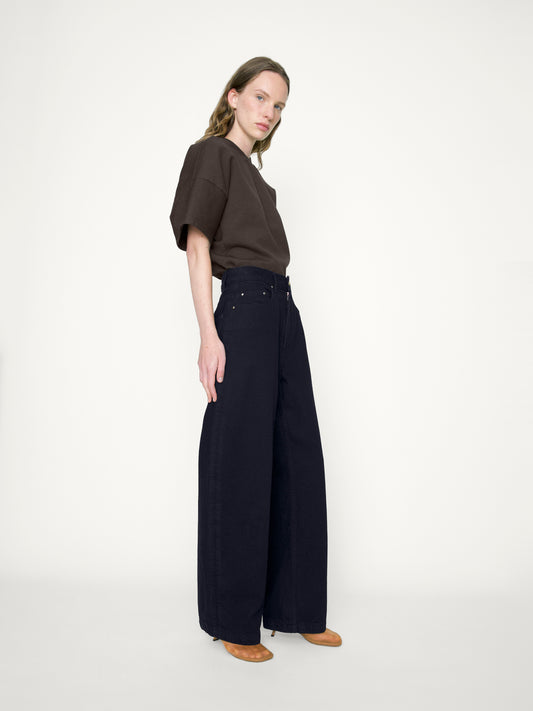
Nina wears the Bends Jean in Dusk Wash
Nina wears the Bends Jean in Dusk Wash Shop Now →

O: How do you define taste?

NK: I never really thought about taste growing up — I just liked what I liked. It was only when I started working in fashion that I realized it was this idea that was so revered. Your taste level is everything in fashion. I think taste is what happens when an aesthetic person begins seeing critically — when a valence is assigned to an object, the idea of “this is good.” We often appreciate many different things, but the act of exclusion is the point at which we begin constructing a world and a point of view.

O: Do you believe taste is instinctive, or is it built through exposure and rigor?

NK: For sure, exposure and rigor. Our attention to detail is so crucial to taste, and we only understand detail unless we’ve seen the things that make up the world. Seeing something without context means you can’t really place it at all — you cannot understand its place in a visual order of your own making. Developing your sense of what fits and doesn’t fit in your world is a conscious act.

But the mark of all this visual input is an almost instinctual sense of how to create something new and what might be good with your minds’ eye. I think that’s why it’s so important to explore many visual ideas and mediums, because you don’t want that instinct to be derivative — you want it to be unusual and original.

O: How did you sharpen your own eye?

NK: think I spent so much of my life just absorbing, without really thinking about it. I think the moment I began to understand that there was something about certain pieces that felt different. I didn’t know what it was about these pieces in my wardrobe, but they felt like something apart from most of the rest of my wardrobe. That developed into a more discerning eye for me, and I began to feel more critical about everything I saw. I feel like I switched from a childlike wonder to a point of view.

O: Your work is deeply rooted in silhouette and construction—what did you have to unlearn to arrive at the language you use now?

NK: I think Ossou is a very raw brand — it is very much about a return to roots and a return to fundamental forms. More interesting, perhaps, is all the things I didn’t learn in the first place — sometimes I think that having taught myself to some degree and learning about construction through work means that I see things through an engineer’s mindset. I think a lot about what’s possible, and I think three dimensionally about how we can get clothes to fall on the body.

O: How has your background informed the way you approach denim specifically?

NK: Being from the west, I think I have a different conception of denim. The west is a melting pot of cultures, and what’s interesting is the sense of possibility that exists. Denim was originally a working material that has now become a classic American material, which makes sense.

O: When you step into a new discipline or problem, how do you teach yourself?

NK: Because of my background, I tend to be quite analytical about things at first, but then I switch. I will often pick up a book and start that way, but after I’ve started, I’ll feel my way around developing my own process. 

O: What’s the most uncomfortable part of being a beginner?

NK: The fear. You are really exposed when you try something new, you don’t have anything to fall back on. And oftentimes, what you can imagine does not match your ability to execute and that’s very frustrating and vulnerable at the same time. Most people are not familiar with learning new things through adulthood too, so it’s doubly hard. There’s definitely an expectation that people have that you’ll only ever do something you’re immediately good at, but true growth involves living with being bad at something for a minute.

O: What can only be earned through repetition and time?

NK: Reputation. That’s what makes growing a brand so difficult — it takes time for people to understand and know your brand. Being seen and understood is perhaps the thing that’s most rewarding in life and brand building.

Nina wears the Cinch Shirt in Dusk Wash
Nina wears the Cinch Shirt in Dusk Wash Shop Now →

O: How does your process change between things you’ve mastered and things you’re still discovering?

NK: I don’t think I’ve really mastered anything — I am always looking at ways I can grow and be better. I also think being great at something involves a certain amount of constant movement outside of your comfort zone.

O: What does excellence look like to you in design?

NK: Uniqueness, point of view, and storytelling. I think it’s reductive to think of design as being about creating something beautiful or aesthetically pleasing, but rather its power lies in when we really push beyond where we’ve been into something new. The hard part of the new is that it has to be cohesive and speak to what came before it, too. Design without roots in culture is just pretty drawings.

O: What does it mean to trust your eye?

NK: Sometimes it’s less about trusting your eye and more about giving yourself the chance to follow an instinct. It doesn’t always work out, but sometimes you get something really interesting.

O: How do you know what’s good while you’re still inside the work—before it’s resolved?

NK: I like to picture something in my mind’s eye, and imagine it on the body. The posture that it creates within the wearer is the most interesting part to me. In a larger sense, there’s a feeling I want from the thing, an emotion, and if I can picture the finished product and it’s got that, I know it’s good. As soon as I feel it’s not going to get there, I usually want to kill it. But sometimes I’m wrong and things feel good but different, so sometimes it is worth following through.

O: Where do you go—mentally or physically—when you need to see differently?

NK: I am a talker, I find it helpful to talk things out with people who are smart and insightful. I find where two people can get to is more interesting than where you can get to alone in your head. Plus, when you’re forced to verbalize things that you’ve only thought about something in an abstract manner in your head, there’s something very clarifying about putting it into words.

O: Was there a moment that reoriented what you wanted to make, or who you wanted to become?

NK: I think there was a moment where I came to understand clothing as not just a problem of designing a good product, but this challenge of creating a world and thinking through an aspiration. We often dress for the people we want to be, the way we want to see ourselves, and creating and reflecting a vision of what is aspirational is so fundamental to what we do.

O: Visually, what always stops you in your tracks?

The handmade. It’s odd, because I love clean, geometric lines in fashion and accessories, but whenever I see a painting, sculpture, or even a piece of furniture, I love something that leaves finger prints of the way it was made. A textured brush stroke, the texture of a carving tool, these details add a warmth to an inanimate object that I respond to so viscerally.

O: What are three truths about design you wish everyone understood?

NK: Aesthetic talent is something you have to work at just as much as anything else. Creativity is a process, and you have to learn to be a little shameless. Collaboration is a process of understanding an intersection between two people.

O: If you could make anything next, in any medium, what would it be?

NK: Furniture was the very first thing I ever wanted to design, and I’m kind of obsessed with the idea of being a furniture designer still.

Nina wears the Bends Jean in Dusk Wash
Nina wears the Bends Jean in Dusk Wash Shop Now →
Follow Nina

Shop Nina's Look

Neada Deters

with Neada Deters

Read Now →

Neada Deters
  • Nina Khosla
  • Nina Khosla
  • Nina Khosla
  • Nina Khosla
  • Nina Khosla
  • Nina Khosla
Nina Khosla for Ossou
Shot by Lelanie Foster

1 of 6