Talia Shuvalov
Co-Creative Director of Ossou, Co-Founder of EREDENew York, NYPHOTOGRAPHY
Fujio Emura

Talia Shuvalov, the Co-Creative Director of OSSOU and Co-Founder of EREDE, is an intuitive designer whose eye for proportion, texture, and color plays a key role in shaping the foundation of the brand. She approaches design with a quiet discipline formed through years of working closely with product, materials, and construction, an approach also reflected in EREDE, the fine jewelry brand she co-founded in 2023. Rooted in the balance between purpose and emotion, her work reflects a belief that the most enduring pieces are those that are lived in— returning to the wearer again and again, deepening with time.
Raised in Sydney within a fashion family, her relationship to clothing began not with the romance of dressing, but with the reality of making — yarns, machines, production runs, and the steady rhythm of building something with care. That early proximity to process shaped the way she approaches design today: with patience, precision, and a deep respect for the life a piece will live once it leaves the studio.
We sat down with Talia to talk about instinct, taste, and the discipline of refinement — how design evolves through repetition, why the best objects earn their place over time, and what it means to trust your gut in the middle of making something new.
OSSOU: What have you been unexpectedly drawn to lately?
TALIA SHUVALOV: Lately, I’ve been unexpectedly drawn to color — a lot of it.
My instincts have always leaned toward restraint. I’m naturally quite minimal in my taste and have long been drawn to neutrals. In many ways, OSSOU was born from that sensibility, the idea of expanding denim into a more nuanced and diverse neutral palette.
But recently I’ve felt myself pulled toward color in a new way. It feels less decorative and more emotional, another language for expressing mood and energy. It’s been an interesting shift, letting that instinct open up a bit.
O: Where do you come from as a designer?
TS: I’ve always been deeply product-driven. I think as much about the function and end use of a piece as I do about the emotional and visceral connection someone might have with it. For me, the most compelling design lives at that intersection — where something is both purposeful and deeply felt.
I’m drawn to objects that earn their place in a wardrobe. Pieces that work hard, that return to you again and again, and that reveal more of themselves over time. I believe the best design isn’t just admired; it’s lived with.
More and more, my process has also become about instinct. After years of working with product, materials, and construction, there’s a certain point where you have to trust your gut. The process becomes less about forcing an idea and more about listening — allowing the piece to find its natural form. When that happens, the result often feels inevitable, almost as if it was always meant to exist that way.
O: When did fashion shift from something you wore to something you did?
TS: For me, it never really made that shift — it has always been something I did. I grew up around it. My mother was a designer, and from my teenage years I worked alongside her, so fashion was never just about getting dressed. It was about making, thinking, and building. It was a process and a practice long before it was something hanging in a wardrobe.
With OSSOU, those two ideas have come together in a very natural way. The work and the wearing feel inseparable. Everything we design begins from a place of personal desire — pieces we genuinely want to live in ourselves. So the act of making and the act of wearing collapse into the same gesture. Fashion becomes both the work and the life around it.
How did where you grew up shape your relationship to clothes, objects, and style?
Growing up in Australia shaped my relationship to style through a sense of ease. Clothing there tends to be relaxed and purposeful. Pieces need to work with the climate and with daily life rather than feel overly precious. That idea of effortlessness has always stayed with me.
But even more formative was growing up inside my mother’s fashion business. From a young age I worked with her developing knitwear, and it was very much a family operation. My grandparents were involved as well, what we jokingly called a “schmata business.” Fashion in our house was never distant or romanticized. It was hands on. It was yarns, machines, production, and the rhythm of building something together.
That experience shaped how I think about style. For me, style is not about spectacle. It is about intention and substance. It is about creating objects that work in real life and that people develop a relationship with over time. Growing up in that environment taught me that the most powerful style often comes from things that are honest, thoughtful, and built with care.
O: What is taste?
TS: Taste is, at its core, a kind of instinct — a gut feeling. But it’s not an arbitrary one. It’s the quiet accumulation of everything you’ve absorbed over time: what you’ve seen, made, loved, rejected, and refined.
It’s a sensitivity that develops through exposure and experience, until certain things simply feel right. You can analyze it later, but in the moment it’s often immediate and intuitive — a recognition rather than a calculation.
For me, taste is that inner compass that helps you edit the world. It allows you to distill complexity down to what feels essential, honest, and resonant. In that sense, it’s less about preference and more about clarity.
O: Is it innate, or can it be learned?
TS: I think there is certainly an innate sensitivity some people are born with — an instinct for proportion, harmony, or what simply feels right. But taste isn’t fixed. It’s something that sharpens over time through exposure, curiosity, and practice.
The more you look, make, question, and refine, the more precise that instinct becomes. So while the seed may be innate, taste is really cultivated. It evolves as you do.
O: How did you develop yours?
TS: Over time, through practice and exposure, your taste becomes more distilled.
O: How did you learn to design jewelry?
TS: Self taught.
O: What is your background, and what did you have to unlearn?
TS: My background is in fashion, so moving into jewelry meant learning to design in an entirely different medium. What surprised me most was how much I had to let go of the instincts I had built around scale and proportion in clothing.
Garments exist in dialogue with the whole body, while jewelry operates on a much more intimate scale. I had to quiet some of my assumptions and relearn how to think about proportion, weight, and presence in a different way.
In many ways it required trusting my instincts again, but through a new lens.
O: How do you approach learning something new?
TS: I try to start from the ground up. Understanding the fundamentals first creates a foundation you can actually build on. From there it becomes about curiosity and a willingness to work very hard.
Finding someone experienced to learn from is also invaluable. A mentor, or simply someone generous enough to share their knowledge, can accelerate that process in ways you cannot achieve alone. It is really a combination of humility and discipline.
O: What’s the hardest part of that process?
TS: The hardest part is staying comfortable in not knowing. In the beginning there is a lot of uncertainty, and progress can feel slow.
O: What is the advantage of being new at something?
TS: The advantage of being new at something is that you are not yet constrained by the rules. It may sound cliché, but not knowing all the conventions can actually be liberating.
When you are unfamiliar with the boundaries, you often push past them without hesitation. There is less anxiety about whether something is allowed or correct, and more freedom to follow instinct and curiosity.
That openness can lead to ideas that feel fresh and unexpected. Sometimes the most interesting solutions come from approaching a field before you fully understand where its limits are supposed to be.
O: What can only be earned through time and repetition?
TS: Clarity of instinct.
O: What does it mean to be excellent at something?
TS: Relentless refinement.
O: How do you build confidence in a new discipline?
TS: Practice and patience. Lots of patience.
O: How do you know what’s good while you’re in the middle of making?
TS: Instinct. That's it – you have to trust it.
O: When do you know something is right, and when do you second-guess?
TS: If you’re unsure, it’s usually not right.
That said, sometimes distance helps. With a bit of time you can return to something and see it more clearly, either confirming that instinct or recognizing that it needs refinement.
O: What is design about?
TS: For me it's about process and refinement.
O: From a bird’s-eye view, what is your process?
TS: Honestly, the process changes from season to season depending on the inspiration. Sometimes we begin with color, with a very strong sense of tone and texture. That often leads to a deep exploration of textiles and surface.
Other times it begins with a narrative or a small object that sparks a larger idea. From there the collection slowly takes shape through materials, proportion, and refinement. Each season unfolds a little differently, but the process is always about following the initial spark and allowing it to evolve.
O: Where do you go for inspiration?
TS: Books, museums, and simply paying attention. I find inspiration in looking closely at the world around me. Often it is less about searching for ideas and more about developing a trained eye.
Inspiration can really come from anywhere but lately even places like drouot.com have been surprisingly inspiring. You can discover the most unexpected objects there. Recently we found these beautiful vintage perfume bottles that became the starting point for Spring 26. The colors and textures translated directly into the collection and shaped how we thought about the palette and surface.
O: What comes easily to you that probably shouldn’t?
TS: Editing.
O: Was there a moment that fundamentally changed what you wanted to do, or who you wanted to be?
TS: Having children shifted the way I think about my process. Time becomes much more defined, and much more precious.
It made me realize that the act of making is something quite sacred to me. My process is not just a means to an end. It is a space that exists for me, a place where I can think, experiment, and reconnect with my instincts.
In a way, becoming a parent clarified that creative time is not something to squeeze in around life. It is something I protect, because it is where the work and the ideas truly come from.
O: What’s something unexpected about how you work?
TS: Something unexpected about how I work is that my process is quite chaotic, but my environment needs to be the opposite. Creativity for me often happens in a swirl of ideas, sketches, and experimentation. Because of that, I need my surroundings to be calm, organized, and quiet. That sense of order creates the space where the chaos of the work can unfold productively.
O: Visually, what will always stop you in your tracks?
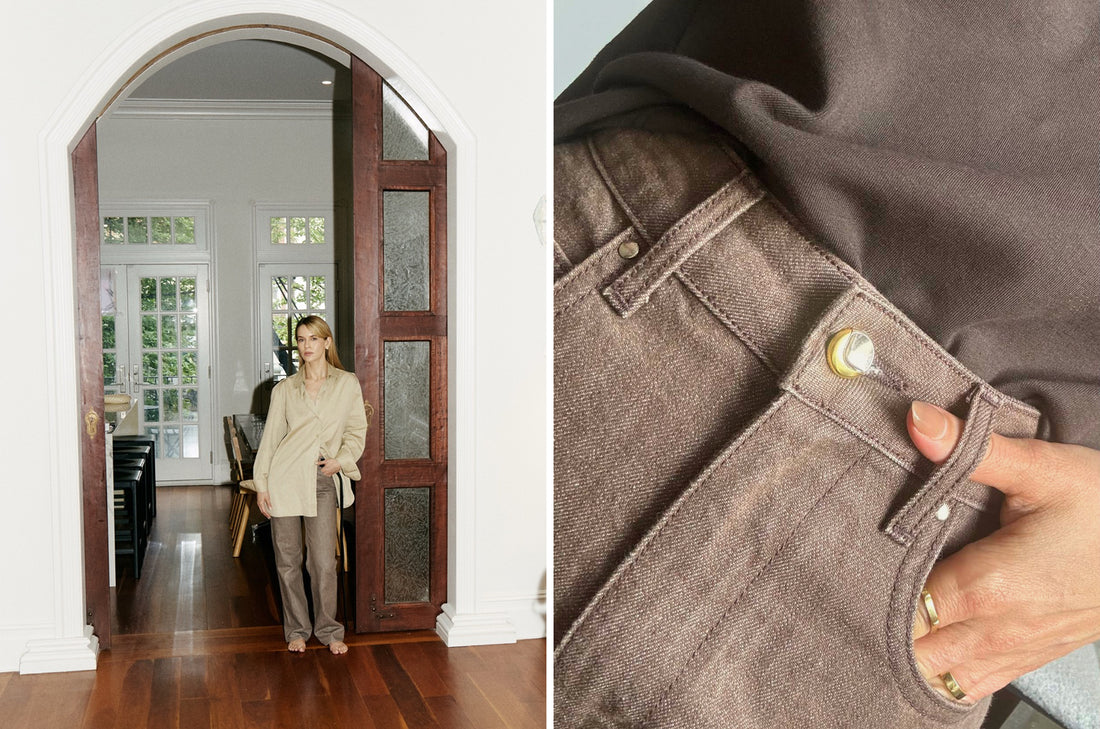
TS: Perfect denim. The right wash, the right weight, the right proportion. It is deceptively simple and almost impossible to get exactly right, which makes it endlessly compelling.
O: What would your next dream project be, in any field?
TS: I have a crazy dream of working in wearable technology one day.
O: What are the biggest misconceptions people have about fashion?
TS: One of the biggest misconceptions about fashion is that it is glamorous. From the outside it can appear that way, but the reality is far more grounded. Fashion is a discipline built on process, persistence, and an enormous amount of unseen work.
Behind every garment is a long chain of decisions. There are fittings, technical adjustments, fabric sourcing, production challenges, and constant problem solving. It is both creative and deeply practical.
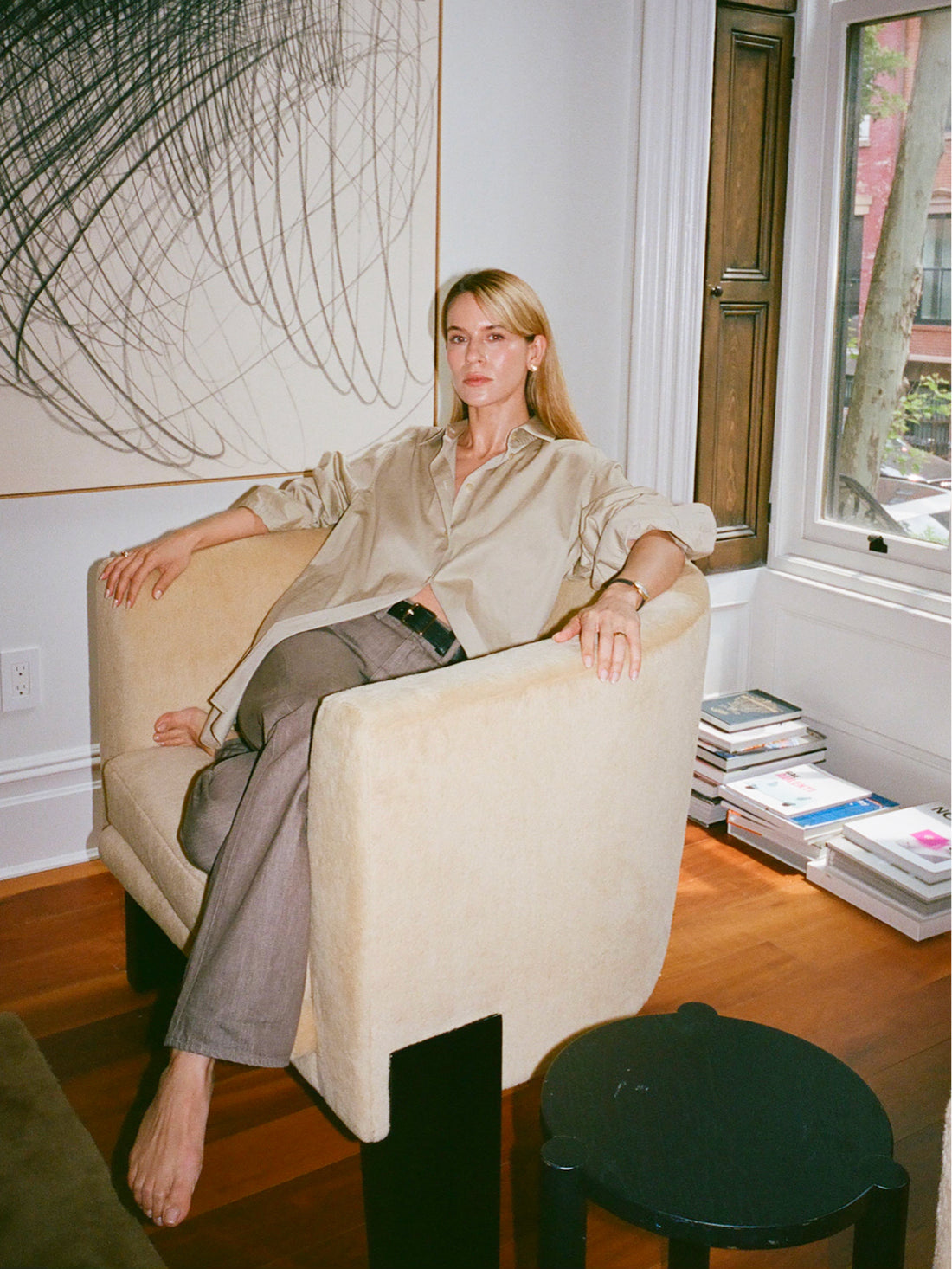


Talia Shuvalov for Ossou
Talia Shuvalov for Ossou
Shot by Fujio Emura
Talia Shuvalov for Ossou
Shot by Fujio Emura
1 of 5